
 Most electronic product development projects overrun on cost, schedule, or both. The single most common root cause is not a technical failure. It is a brief that was too vague, too prescriptive in the wrong places, or missing critical information about the operating environment, compliance route, or production volume.
A good electronic design brief is the highest-leverage document in the entire project. It shapes the architecture, drives the quotation, and determines whether the finished product is manufacturable, certifiable, and profitable. Time spent getting it right pays back many times over.
This guide walks through the nine sections every strong brief contains, the mistakes that cost OEMs the most, and a structure you can adopt directly for your next project. Whether you are commissioning your first custom product or your fiftieth, the principles are the same. Define the problem clearly, capture the environment honestly, and flag the unknowns openly.
What an Electronic Design Brief Actually Is, and Why It Matters
An electronic design brief is the foundational requirements document agreed between a client and their design partner before engineering work begins. It is not the same as a product requirements document, which expands the brief into testable detail later in the project. It is also distinct from a statement of work, which sets out commercial terms.
The brief sits earlier and higher. It captures what the product must do, the conditions it must do it in, and the commercial reality around it.
The consequences of a weak brief are commercial, not just academic. You receive inaccurate quotes that have to be revised mid-project. Scope creeps. Redesigns eat into margin. Certification surprises push launch dates.
A strong brief lets a design partner give you a fixed-price quotation against a defined scope, which is what most OEMs actually want. At DSL we treat the brief as the first technical checkpoint in any new engagement. Our design process starts with requirements definition for exactly this reason, and we published a requirements definition template clients can use as a starting point.
The 9 Essential Sections of a Strong Electronic Design Brief
The structure below works for almost any electronic product, from a single-board sensor to a complex multi-board industrial system. Use it as a working template.
1. Project Background and Commercial Context
Start with the why. Explain the problem the product solves, the market it serves, and how the end user will actually use it. Note whether this is a new product, a redesign of an existing one, or a variant of something already in production.
Include commercial drivers: target launch window, competitor benchmarks, and how strategic the product is to your business. A design partner who understands the commercial context can make better engineering trade-offs.
2. Functional Requirements
Describe what the product must do, expressed as observable behaviours. List inputs, outputs, signals, communication protocols, and interfaces with any existing equipment. Capture the modes of operation and the expected user interactions.
The most important rule here: describe the problem, not the solution. Avoid pre-selecting microcontrollers, sensors, or circuit topologies unless there is a sound commercial reason, such as an approved vendor list or compatibility with installed hardware. Pre-selection often closes off better options.
3. Performance and Environmental Requirements
This section is routinely the weakest in first-draft briefs and the most expensive to fix later. Cover:
- Operating and storage temperature range
- Humidity, vibration, and shock requirements
- Ingress protection rating where relevant
- EMC environment and target class
- Reliability targets, such as MTBF expectations
- Power budget and thermal envelope
A product destined for a temperature-controlled office is a fundamentally different design from one that lives on a factory floor or inside a vehicle. State the conditions clearly, even if they feel obvious.
4. Mechanical and Physical Constraints
Specify enclosure dimensions, weight limits, mounting arrangements, and connector positions. Note any interfaces with existing mechanical assemblies, housings, or panels. Flag materials, finishes, and aesthetic requirements.
Make clear whether enclosure design is in scope for the design partner or supplied by the client. DSL’s mechanical design capability covers both routes, but the brief should state which applies so the quotation reflects it.
5. Power, Battery, and Connectivity
Define the power source: mains, battery, Power over Ethernet, or harvested. For battery-powered products, specify chemistry, expected runtime, charge cycle expectations, and whether the battery is replaceable.
Cover wired and wireless connectivity. List the protocols you need, from Ethernet, USB, CAN, and RS-485 through to Bluetooth, Wi-Fi, LoRa, and cellular. Note expected data rates, latency tolerance, and any security expectations. These choices propagate through the entire design.
6. Compliance, Certification, and Target Markets
List the geographic markets you intend to sell into. The compliance regimes follow from there: UKCA and CE for the UK and EU, FCC for North America, and others as required.
Then list the sector-specific standards that apply. Examples include EN 60601 for medical devices, DO-160 for airborne equipment, IEC 61508 or ISO 26262 for functional safety, and IEC 62443 for industrial cybersecurity. State whether you need pre-compliance work, full compliance, or third-party certification, and what documentation you expect to receive. DSL’s approvals experience covers most regulated sectors, but the brief must define the route.
7. Production Volume, Target Cost, and Lifecycle
Give an honest annual volume forecast and total programme volume. A design optimised for one hundred units per year is fundamentally different from one optimised for one hundred thousand. Briefs that say “we will start small and scale” without honest numbers lead to suboptimal decisions early.
State a target landed cost per unit, the expected service life of the product, and your expectations around component obsolescence and second sourcing. A good electronic design brief looks ten years ahead, not just to first production.
8. Project Timeline and Milestones
Identify hard deadlines such as a trade show, a regulatory submission, or a contractual delivery date. Note soft milestones for prototype, design review, pilot build, and production release. Flag dependencies on third parties, including enclosure suppliers, certification bodies, or your own internal sign-off processes.
Realistic timelines built into the brief are far more useful than aggressive ones imposed later.
9. Risks, Unknowns, and Open Questions
Reserve a section for the things you do not yet know. Areas where you want the design partner’s input. Known technical risks such as novel sensing, tight thermal margins, or untested protocols. Commercial risks such as volume uncertainty or evolving standards.
This section often saves weeks later. It signals that you understand the project is collaborative and gives the design partner permission to bring expertise to the parts you have not fully resolved.
Common Mistakes That Weaken a Brief

Even experienced product teams fall into the same traps. The most common are:
- Over-specifying the solution while under-specifying the problem
- Omitting the operating environment, especially temperature, EMC, and ingress
- Treating a working dev-board prototype as a near-complete design
- Forgetting production test and calibration strategy
- Giving an unrealistic volume forecast to secure a lower quote
- Leaving compliance until pre-compliance testing
- Withholding so much under NDA that proper scoping is impossible
Each of these has a commercial cost. An unrealistic volume forecast, for example, leads to component choices that work at low volume but become uneconomic at scale, which means a redesign before the product is even profitable.
Worked Example: The Same Project, Two Briefs
Consider a ruggedised wireless sensor node for a factory automation application.
A weak brief reads: “We need a wireless temperature sensor for industrial use, battery powered, low cost, ready in six months.”
A strong brief covers the same product but specifies an operating range of minus twenty to plus seventy degrees Celsius, IP65 ingress, EMC compliance to industrial Class A, a wireless protocol family, expected battery life of five years on a single primary cell, an annual volume of ten thousand units, a target unit cost, the geographic markets, and the certification route.
The difference is decisive. From the weak brief, no design partner can quote with confidence. From the strong brief, architecture choices follow naturally: which radio, which microcontroller family, what sealing strategy, what test approach. The quotation is accurate, the schedule is realistic, and the risks are visible. The project becomes possible to manage rather than a series of expensive surprises. This kind of upfront definition is also what makes PCB design work efficiently downstream, because the constraints are known before layout begins.
How to Work With Your Design Partner Once the Brief Is Submitted

A finished brief is the start of a conversation, not the end of one. Expect a clarification round before quotation, and welcome it. The questions you receive often reveal gaps that are far cheaper to address now than after design work begins.
Be prepared to revisit the brief after the initial design review. Agree a change control process so that scope changes are recognised, quoted, and approved rather than absorbed silently. Clarify intellectual property ownership, deliverables, and confidentiality before detailed work begins. A reputable contract electronic design services partner will often sign a mutual NDA as a matter of course.
Engaging early also lets you take advantage of services such as a design health check, which can surface gaps in the brief or in an existing design before they become expensive. This is particularly valuable when you are converting a working dev-board concept into a production design, an area DSL covers in detail in outsourcing proof-of-concept work.
For products that include embedded code, remember that hardware and firmware development decisions are tightly coupled. The brief should make clear whether software is in scope and to what level, because the answer changes the architecture.
Putting the Nine Sections to Work on Your Next Project
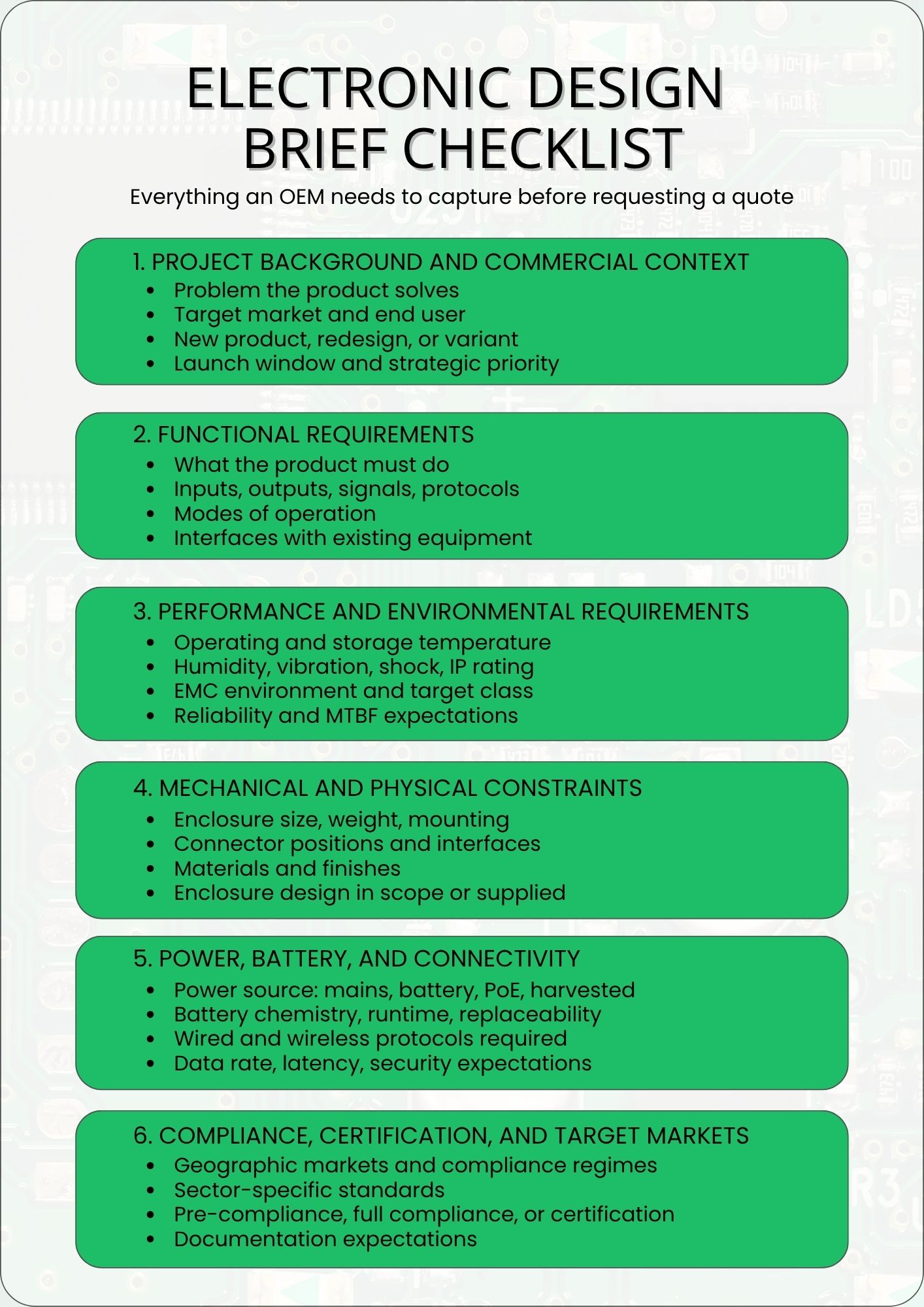
A strong electronic design brief is not paperwork. It is the document that determines quotation accuracy, design quality, and time to market. The nine sections set out above give you a working structure: commercial context, functional requirements, performance and environment, mechanical constraints, power and connectivity, compliance, volume and lifecycle, timeline, and open risks.
Get those nine right and the rest of the project gets easier. The quotation reflects the real scope. The architecture is shaped by the real constraints. The certification route is planned, not discovered. And the relationship with your design partner becomes genuinely collaborative.
Use the structure as a template the next time you start an electronic product development project. Engage a design partner early in the briefing process rather than after the document is finalised, so engineering input shapes the brief while it is still cheap to change. If you want a head start, DSL’s requirements definition template maps closely to the nine sections above and can be downloaded directly. Browse our case studies to see how this approach plays out in practice, or contact us to start a conversation.
Frequently Asked Questions
How long should an electronic design brief be?
There is no fixed length. A simple sensor product might need three to five pages. A regulated medical device can run to thirty or more. The right length is whatever covers the nine sections above without padding.
Do I need to specify components in my brief?
Generally no. Specify the problem, the environment, and the constraints, and let the design partner propose components. Pre-selection is only useful when there is a strong commercial or compatibility reason, such as an approved vendor list.
What is the difference between a design brief and a product requirements document?
The design brief is the earlier, higher-level document used to scope and quote the project. A product requirements document is more detailed and is often produced jointly during the early design phase, expanding the brief into testable requirements.
Can the brief change once the project is underway?
Yes, and it usually does. What matters is having a change control process so that scope changes are recognised, quoted, and approved rather than absorbed silently. Drift without process is what causes cost overruns.
Should I sign an NDA before sharing my brief?
Yes. A mutual NDA is standard practice and should be in place before sharing commercially sensitive detail. A reputable design partner will sign one as a matter of course and can usually provide their own template.


