
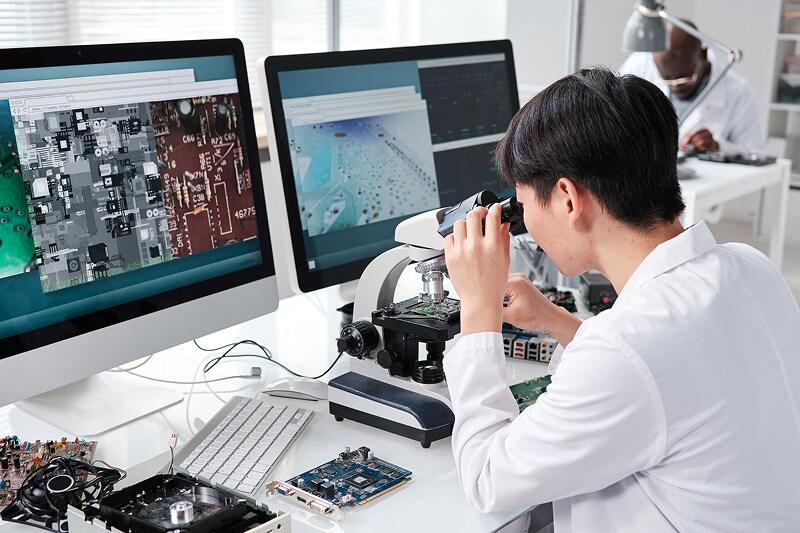
 The prototype works. The lights blink. The firmware runs. The team is celebrating. And yet the product is still months, sometimes years, away from being something a manufacturer can build at volume, at yield, at cost.
This is the gap most OEMs underestimate. “Working prototype” and “production-ready electronic design” sound similar. In practice they are two very different things, separated by a stretch of work where most projects quietly haemorrhage time and money.
This article walks through the seven stages that sit between the two. It also explains why so many of those stages go wrong when electronic design and manufacture sit in separate companies, and what changes when they sit under one roof.
Why a Working Prototype Is Not a Production-Ready Design
A bench prototype proves the concept works once, in one environment, with one set of components. That is a real achievement, but it is not the finish line.
A production-ready electronic design proves something harder: that the product can be built repeatably, at predictable cost, at the volumes you actually need, by people who were not in the room when it was designed. It needs a documentation package that any qualified manufacturer could follow and produce the same result.
Put simply, a working prototype passes a demo. A production-ready design passes a five-year warranty.
Stage 1: Requirements Capture and Feasibility
Every successful project starts with a written brief. What the product must do. The environment it will operate in. The lifecycle you expect. The regulatory targets. The target cost.
This stage is often rushed because everyone wants to start drawing schematics. Yet the decisions made here drive roughly 80% of the eventual BOM cost.
A good design partner will ask hard questions before they quote, not after.
Stage 2: Architecture and Component Strategy
Architecture is the block-level view. Which microcontroller family. FPGA or fixed-function silicon. Wired or wireless. Power topology. These choices set the technical and commercial shape of the entire product.
Designing With Second Sources From Day One
The component shortages of recent years changed how serious design teams think.
Component lifecycle status is now a first-class design constraint, not an afterthought. Specifying second sources at the architecture stage protects the project from years of obsolescence risk.
A medical device OEM once arrived at the quotation stage with a finished prototype, only to discover three components on its BOM had lifetime buys pending. The redesign delayed launch by nine months.
None of it was visible on the bench. All of it was visible at architecture stage, if anyone had looked.
Stage 3: Schematic Capture and PCB Layout
This is where the design becomes real. Schematic capture covers the electrical design itself: component selection, protection circuitry, signal integrity, power distribution. The PCB design service stage then turns that schematic into a physical board, with all the trade-offs that entails: layer stack, routing, impedance control, thermal management, EMC considerations.
A lot of late-stage problems trace back to layout decisions made in isolation from manufacturing reality. Footprints that do not match real parts. Components placed too close to the board edge. No room for test points. These are not failures of skill. They are failures of conversation.
Stage 4: Firmware and Software Development
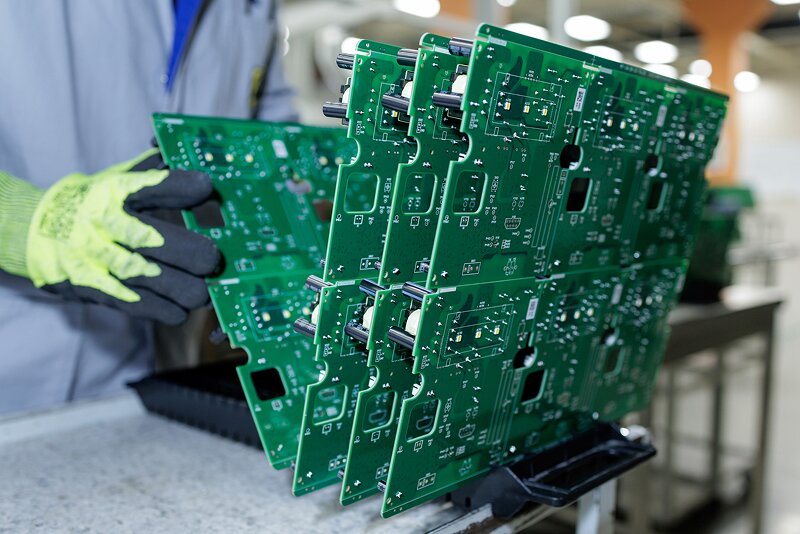 Hardware rarely works on its own. Most products need firmware and software running in parallel with the hardware design: bring-up code, drivers, application logic, communications stacks.
There is also a quieter category of firmware that often gets forgotten: the code needed for production. Bootloaders. Test routines. Programming fixtures. A manufacturer needs to programme boards on a line, not on an engineer’s desk. Production firmware is part of production readiness, not separate from it.
Stage 5: Prototyping, Verification and EMC
This is where physical units get built against the specification. Functional testing checks that the product does what it should. Environmental testing checks that it keeps doing it across temperature, vibration and humidity. EMC pre-compliance checks whether it will pass certification later.
Running EMC pre-compliance early, during prototyping, is one of the cheapest decisions a project can make. A telecoms OEM that did exactly this caught a layout issue at the prototype stage. One board spin instead of three. The full approvals process becomes far less painful when problems surface early.
Stage 6: Design for Manufacture as a Continuous Discipline
The old model treated design for manufacture as a final review, a gate at the end of design. The mature view is different. DFM happens at architecture, again at schematic, again at layout, and again before release. It is a discipline, not a checkpoint.
A proper DFM review looks at:
- Component availability and lifecycle status
- Whether parts can be placed by a standard SMT line
- Test point access and test strategy
- Inspection access, including compatibility with 3D AOI inspection
- Clear copper and component setbacks from board edges
An industrial sensor manufacturer once had a connector on its design that required hand-soldering. Spotted at DFM review, it was swapped for a surface mount alternative. Labour cost dropped on every unit produced from that point forward. That is what good DFM does. It pays for itself, often many times over.
If you have a design currently sitting in this middle ground, a Design Health Check is the cheapest way to find out where it stands.
Stage 7: Design Transfer, the Handover That Makes or Breaks Production
Design transfer is the moment a finished design package moves from the design team to the manufacturing team. It is the most expensive moment in any electronics project, and the one most often handled badly.
A proper transfer package contains schematics, a BOM with qualified suppliers, Gerber files, assembly drawings, test specifications, firmware, and programming files. It should be ready for PCB assembly without a second round of questions.
The two failure patterns are familiar to anyone who has worked in this industry. The first is the “throw it over the wall” problem: the design house finishes its part, the manufacturer inherits a mess of incomplete files, and the two sides spend weeks arguing about whose responsibility it is. The second is “contractor abandonment”, increasingly visible in engineering forums: prototypes are delivered, the design house disappears, and no manufacturer will quote the package as it stands.
Both patterns share a root cause. Design and manufacture were treated as two transactions instead of one continuous process.
The Advantage of Design and Manufacture Under One Roof
When design and manufacture sit in the same building, the seven stages stop being gaps to fall through. They become a continuous workflow.
DFM happens continuously because the manufacturing team is in the conversation from the start. Component selection is informed by what the line can actually place and inspect. Layout decisions are reviewed against real assembly equipment. The design transfer is internal, not adversarial. When something needs clarifying, the engineer is down the corridor, not at the end of an unanswered email.
DSL has spent 35 years building this model. Both the design process and the production line live in the same Hertfordshire facility, with one team accountable for the journey from concept to delivered product. That is what makes a five-year PCBA warranty possible. It is also what makes flexible delivery sensible, because the same team that knows the design knows the production schedule.
It is not the only way to get from concept to production-ready electronic design. But it is the way with the fewest places to fail.
The Seven Stages, Held Together by One Conversation
To recap the journey: requirements and feasibility, architecture and component strategy, schematic and layout, firmware, prototyping and verification, design for manufacture, and design transfer. Seven stages, each with its own pitfalls.
The thing that ties them together is not a tool or a process document. It is a conversation between designers and manufacturers that never has to stop, restart or be rebuilt from scratch.
The most expensive moment in any electronics project is the handover that goes wrong. The cheapest is the one that never has to happen, because design and manufacture have been talking all along.
If you have a project sitting somewhere in this middle ground, a free Design Health Check from DSL will tell you exactly where it stands, what it needs, and what it would cost to finish properly.
Frequently Asked Questions
How long does it take to go from concept to production-ready design?
Anywhere from 6 to 18 months, depending on complexity, regulatory requirements and how many prototype iterations the design needs. Projects with manufacturing input from the start tend to land at the shorter end of that range.
What is the real difference between a prototype and a production-ready design?
A prototype proves the concept works. A production-ready design proves the product can be built repeatably, at yield, at cost and at volume, with a documentation package any qualified manufacturer can follow.
When should I involve a manufacturer in the design process?
At architecture stage, not at the end. Decisions made early dominate lifetime cost. Late-stage manufacturing input usually means costly redesigns.
What goes wrong in a typical design transfer?
End-of-life components on the BOM. Footprints that do not match real parts. No panelisation guidance. No test strategy. And no one available to answer questions when the manufacturer hits a problem.
What is a Design Health Check?
A structured review of an existing electronic design against manufacturability, component lifecycle status, testability and cost. DSL offers this free of charge for OEMs wanting a second opinion before committing to production.


